Research
Experimental fluid dynamics, turbulent transport, and active matter.
My research explores how fluid motion, external forcing, and active swimmers shape transport and energy transfer. I combine laboratory experiments with advanced flow diagnostics to study these interactions.
Rotating convection
Rotation and heating together drive flows inside planets, oceans, and stars. In Earth’s core, the boundary with the mantle is likely uneven — so how does the shape of a boundary change the way a rotating fluid carries heat?
To study this, our team in the Kelley lab built ToRoCo (Topography in Rotating Convection), a laboratory facility in which a rotating, heated water layer can be bounded by interchangeable textured plates. ToRoCo measures the overall heat transport while tracking tracer particles in three dimensions, so changes in heat transfer can be tied directly to the flow structures behind them.
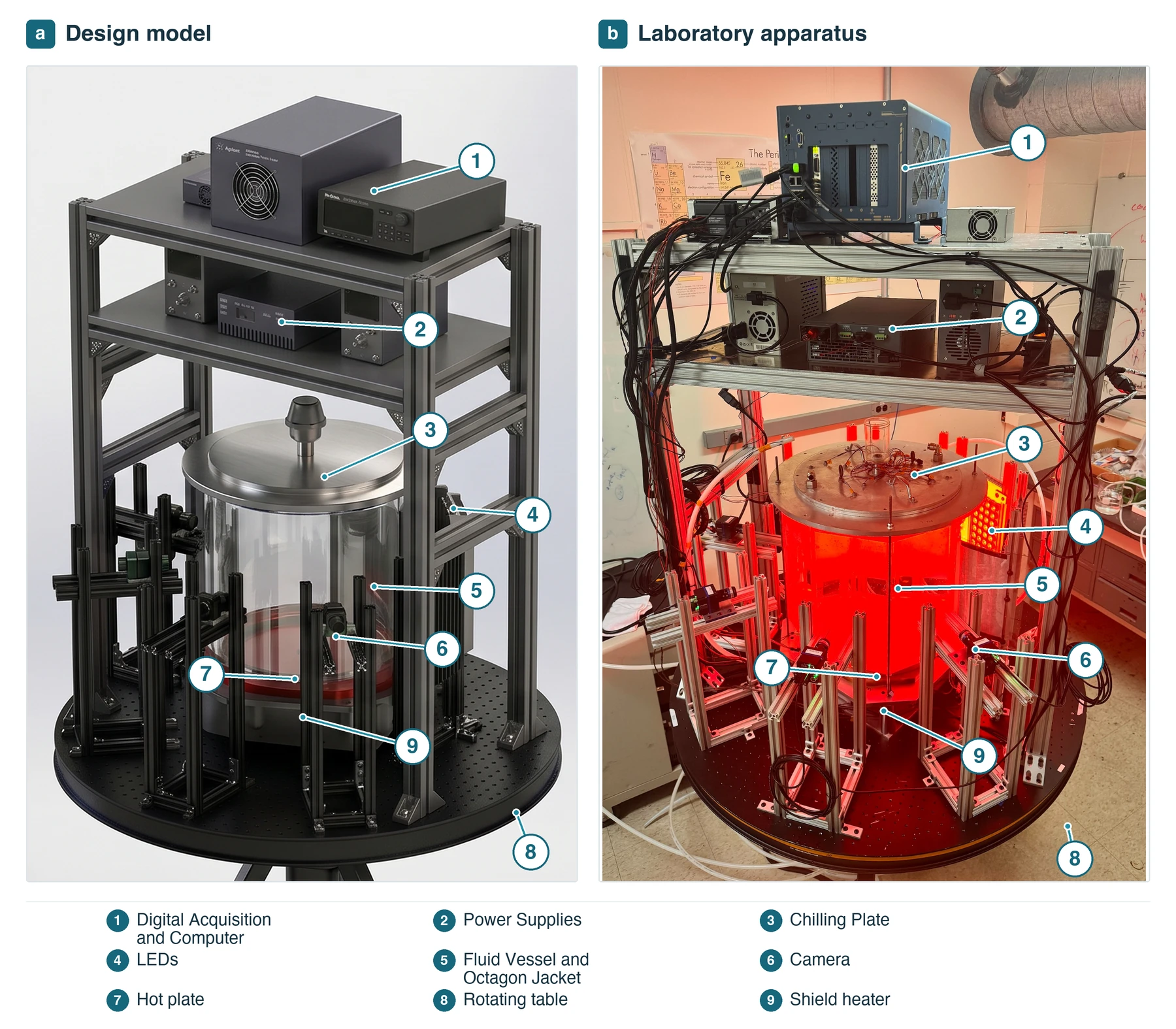
- Digital Acquisition and Computer
- Power Supplies
- Chilling Plate
- LEDs
- Fluid Vessel and Octagon Jacket
- Camera
- Hot plate
- Rotating table
- Shield heater
Tensor geometry and energy transfer
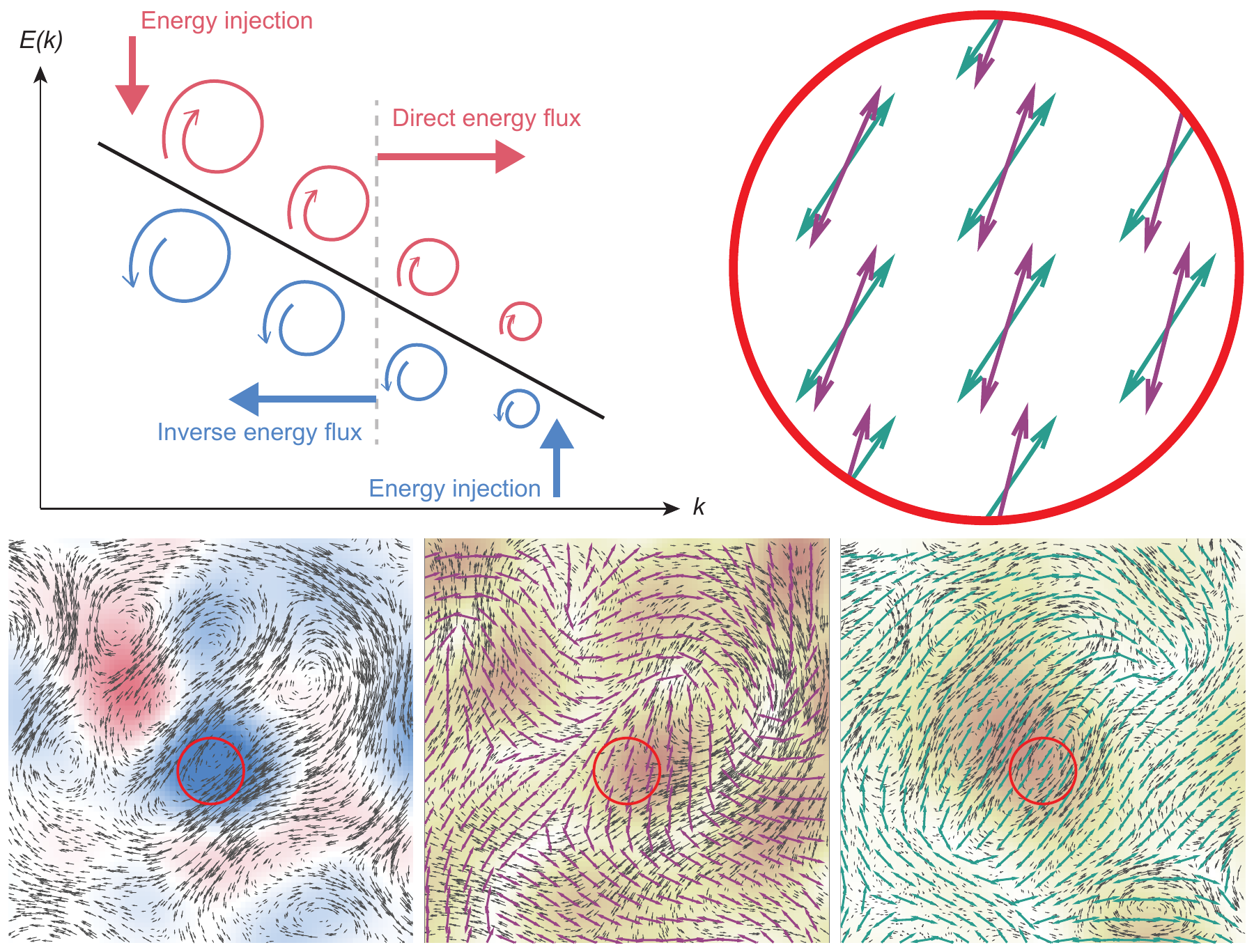
Turbulence passes energy between eddies of different sizes. In three dimensions it usually cascades from large eddies to small ones; in two-dimensional flows it climbs from small to large — a direction long thought to be set by the flow itself.
We found that the direction depends on geometry: whether small-scale stirring works with or against the stretching of the larger flow. Swimming brine shrimp revealed this first, sending energy up or down depending on how they faced the flow. We then turned it into a control knob, flipping the direction of energy transfer by orienting the stirring, and found it works even in slow, viscous flows (featured in Quanta Magazine).
Papers: PNAS Nexus (2024) · Science Advances (2025) · Journal of Fluid Mechanics (2026)
Two-way coupling between active matter and flow
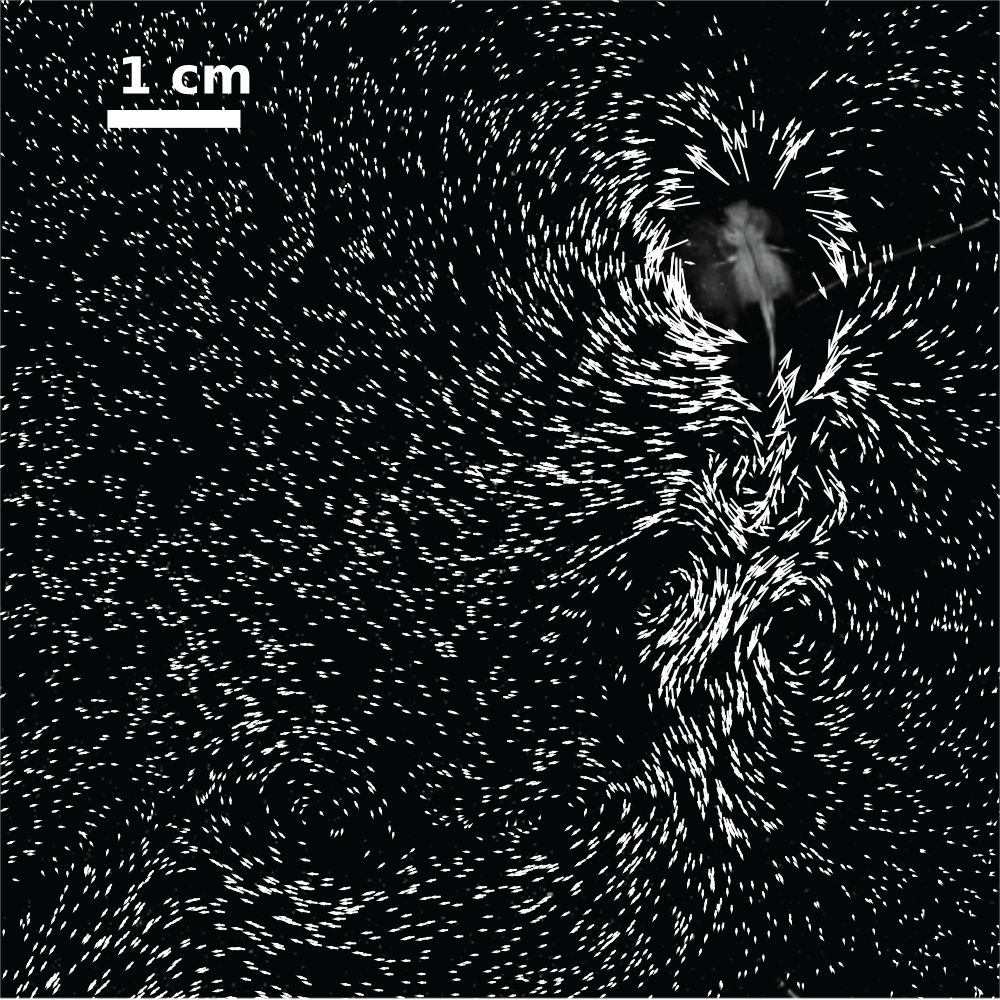
Plankton, swimming microbes, and swarms of small animals all move through flowing water — and they push back on it. My work follows both directions of this coupling.
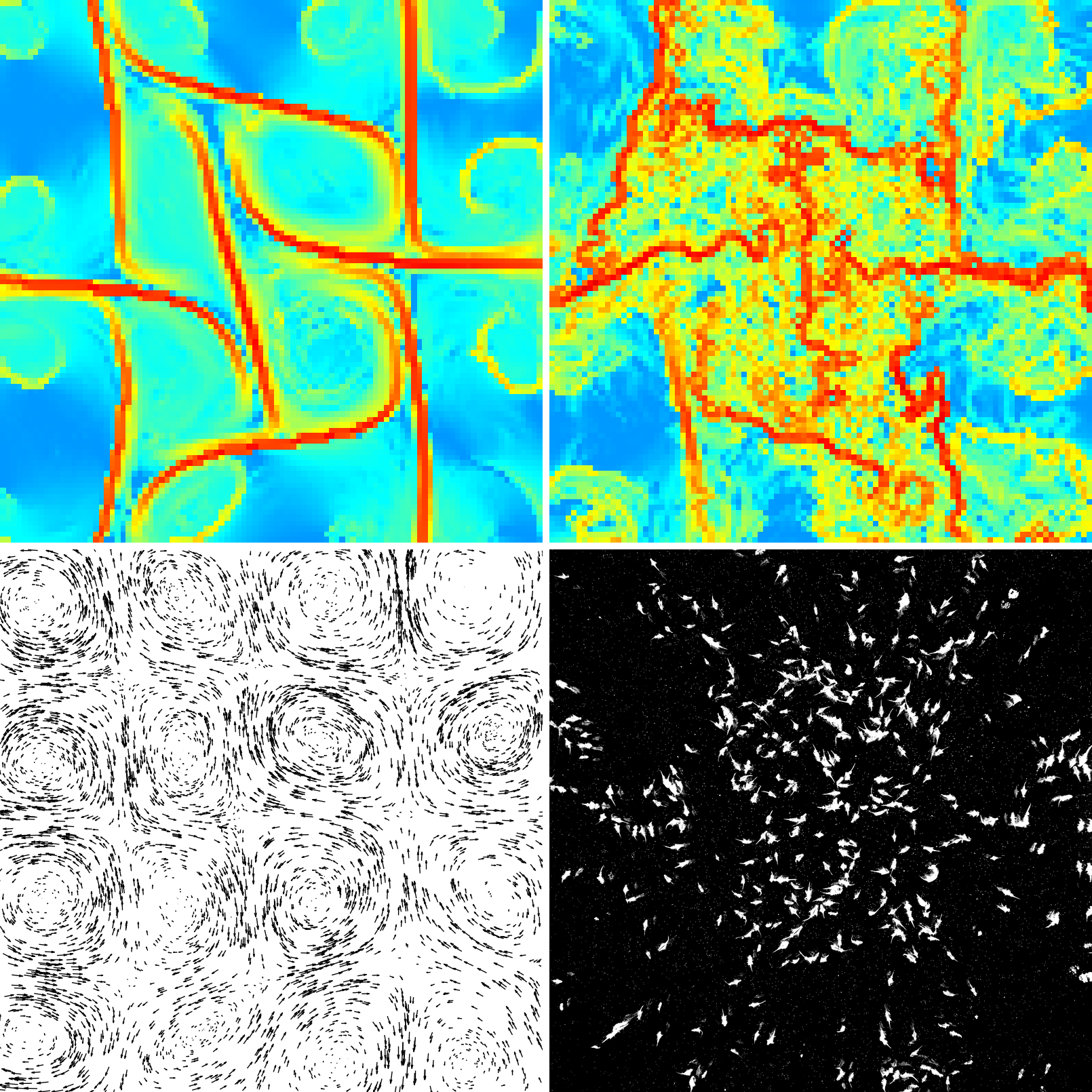
Flows influence the transport of active-matter. Hidden pathways and barriers in a flow, known as Lagrangian coherent structures, shape where swimmers travel and where they gather. Swimmers also reshape the evolution of flow. Even a sparse swarm can shift and twist these structures, with consequences for mixing.
Papers: Physics of Fluids (2021) · Physical Review Fluids (2022) · Physical Review Fluids (2024)
Crowd dynamics


How does a crowd move when everyone tries to keep their distance? Treating pedestrians like particles in a gas, we built a social distance model in which each person heads for a goal while keeping a preferred spacing from others. Tested against experiments, it captures how distanced crowds actually walk.
The model reveals a surprise at doorways: once people’s preferred spacing exceeds the door width, the exit jams. A small angled sidewall beside the door breaks the crowd’s symmetry, and a 30° wall more than triples the outflow without pushing people closer together. As in my work on active matter, simple geometry reshapes collective motion.
Read the paper in Scientific Reports (2021).